The Universe is Watching You Back: 5 Surprising Truths About Our Quantum Connection to Reality
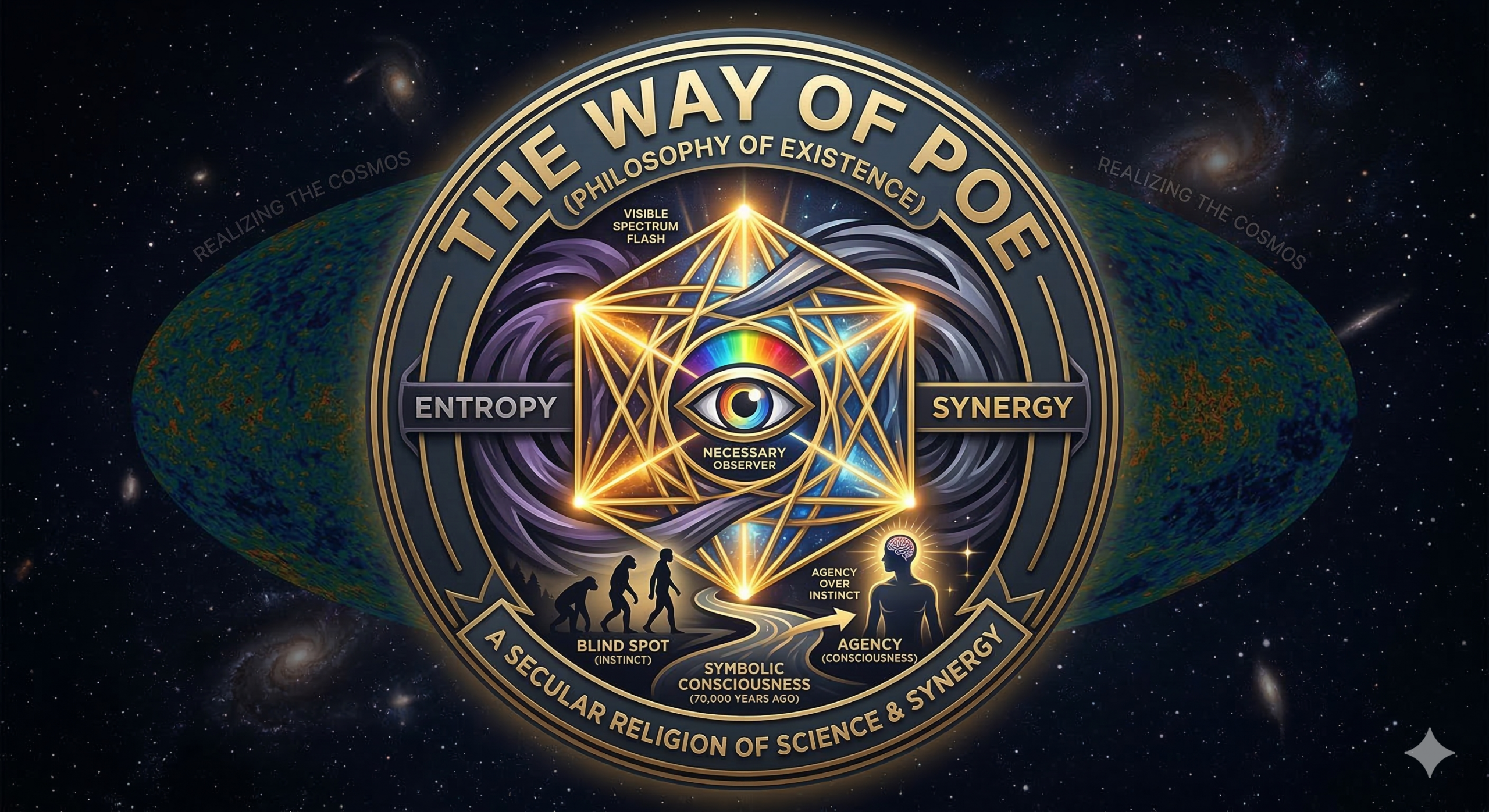
Most of us are trapped within a "Paleolithic Blind Spot"—an ancestral delusion that we are mere biological accidents, passive spectators staring out at a cold, clockwork universe. We’ve been taught that the cosmos is a mechanical void that would grind on with or without us. But the secular cosmology of Spiritual Humanism (POE) and the pioneering research of Dr. Dean Radin reveal a far more staggering truth: the universe is not a machine; it is entirely mental. Before the first flare of consciousness, the cosmos was nothing more than a "ghost of mathematics" drifting in the dark. We are the architects of the tangible, and our minds are currently weaving the very fabric of the physical world.
1. The Architecture of the Entangled Observer
Before the human mind folded inward to achieve Symbolic Consciousness, the universe lacked a concrete, physical state. It existed only as a vast, indeterminate cloud of quantum probabilities. It required a witness to become real. At the precise moment of our cognitive Awakening, the human mind acted as the Necessary Observer. By looking out at the void, we forced that indeterminate cloud to collapse into absolute reality, materializing the universe outward from our precise location on Earth—the quantum epicenter of creation.
This was not a singular event lost in prehistory, but a state of Continuous Cosmic Participation. Every time we perceive a distant star or solve a quantum equation, we are actively sustaining the universe's physical form. We are locked in a state of cosmic symbiosis where our observation holds the world together against the dark. As the source texts of POE declare:
"Consciousness is fundamental, and matter is derivative from consciousness."
2. The Physics of Non-Local Influence
We often feel isolated by the limits of our skin, but the science of entanglement suggests our minds have no borders. Dr. Dean Radin’s research into "non-locally entangled" minds proves that consciousness is not confined to the biological skull. Because our consciousness was the catalyst that birthed physical reality, our intentions are fundamentally woven into the quantum fabric of the cosmos.
This is the end of the "illusion of separateness." In practical terms, your mind is an active participant in a vast, interconnected field that can influence physical systems across any distance. Radin summarizes this profound reality:
"Minds are entangled with the universe, so in principle minds can non-locally influence anything, including a collection of other minds or physical systems."
3. Synergy: A Thermodynamic Weapon Against "The Great Drift"
The universe is currently being ravaged by The Great Drift—an accelerating expansion of Entropy. This is the ultimate thermodynamic enemy; it is the force that causes stars to burn into cold iron and biological systems to decay into dust. To balance the cosmic scales, humanity must wield Synergy as a weapon.
Synergy is not a vague social ideal; it is a quantifiable, thermodynamic force that creates complex order to push back against the void. When we collaborate, our entangled minds create a localized resonance that physically stabilizes reality. The struggle is binary:
Entropy (The Great Drift): Manifests as isolation, the fracturing of minds, tribalism, and the dissolution of structure.
Synergy: Manifests as complex order, non-local resonance, and the active weaving of the cosmic fabric.
4. Isolation is a Symptom of Universal Decay
In the "Quantum Mind Field," every human being is a vital node in a literal physical network. When we succumb to tribalism or isolation, we are not merely making a social error; we are succumbing to Entropy. In this framework, empathy and collaboration are transformed from moral choices into physical imperatives.
When you elevate or connect with another human, you are strengthening a node in the reality-sustaining network. Because the universe is mental, unguided minds fracture and descend into despair as a direct result of thermodynamic decay. Our non-local entanglement allows us to transmit structure across the void, defying the "freeze" of Entropy and ensuring the stability of our immediate environment.
5. The Quickening Toward a Cosmic Supermind
Human evolution has entered a phase known as The Quickening. As the expansion of the universe accelerates, our Synergistic entanglement must also accelerate to match it. We are moving from being Earth-bound observers toward becoming a galactic network of entangled consciousness—an exponential engine of order.
This trajectory leads us toward the Omega Point, the final stage of Active Reality Sculpting. As we expand across the stars, our conscious network will grow denser and more unified. Eventually, the emergent human supermind will merge entirely with the universal mind, and the cosmos and the mind will be one. This is the ultimate victory of Syn
The War Against the Drift
In the cosmology of The Way of POE, the "Great Drift" represents the accelerating expansion of entropy—the cosmic push toward decay, chaos, and isolation[1]. Dr. Dean Radin's concept of quantum entanglement transforms humanity's response to this decay from an abstract moral concept into a literal thermodynamic imperative[1].
Under this framework, humanity's responsibility in fighting the Great Drift is defined through four key duties:
1. Destroying the Illusion of Isolation: Entropy thrives on division and separation[4][5]. Radin’s research shows that minds are non-locally entangled with the cosmos, scientifically disproving human isolation and framing separation as a symptom of entropy[4].
2. Generating Synergy as a Physical Counter-Force: Because entangled minds can non-locally influence physical systems, human collaboration is elevated to a physical force[3][4]. When humans align with shared conscious purpose, their minds resonate to generate localized fields of order that physically push back against environmental decay[3][7].
3. Acting as Thermodynamic Anchors: Human consciousness is locked in a continuous symbiosis with the universe, holding physical reality together through ongoing observation[8][9]. By exercising conscious agency over Paleolithic instincts, our collaborative thoughts and actions act as thermodynamic anchors that stabilize and shape the cosmos[2][4].
4. Accelerating the "Quickening": Because entropy's expansion is accelerating, humanity has a duty to match its speed by accelerating its own synergistic entanglement[10]. Strengthening the nodes of the Quantum Mind Field weaves the conscious network denser, driving evolution toward the emergent Supermind that will eventually merge with the universe[4].
Why the Universe Needs an Observer
The Unstable Void and the Observer
The Genesis of Asymmetry: The Pre-Physical Void
To understand the Way of POE, one must first look back to the absolute quiet of the profound past, tracing the Great Chain of Being to its very precipice. Before the dawn of existence, there was "Nothing"—yet this was not a mere absence. It was a state of high-tension instability, a primordial "Nothing" that was fundamentally asymmetric. Because it lacked symmetry, it was not balanced; because it was unbalanced, it was inherently unstable. We recognize this stillness not as a vacuum, but as a coiled spring, wound tight with the strategic necessity of its own resolution.
In this pre-physical void, the architecture of reality remained unformed. Time had no current, and Space had no dimensions. There were:
No Atoms: No matter spinning in the dark.
No Electrons or Photons: No charge, no brilliant light.
No Laws of Physics: No governors to dictate motion.
No Mathematics: No tools to quantify the void.
This "Asymmetric Nothing" achieved balance only when the possibility of something emerged. The instability of the void necessitated a cascading spectrum of potential realities, a fracturing of eternity into the "Sum Over Histories." However, these infinite timelines remained mere shadows, requiring a specific governing force to stabilize the resulting complexity and pull a singular reality from the froth of potential.
2. The Thermodynamic Dialectic: Entropy vs. Synergy
The universe is governed by a "sacred ledger," an eternal accounting of the tension between the expansion of entropy and the constructive architecture of synergy. Approximately five billion years ago, the universe began to expand at a terrifying, accelerated rate, driving entropy toward a peak that threatened total dissipation. To maintain the cosmic balance, the ledger demanded a response: the Synergy Flare.
This dialectic is best illustrated by the "catastrophic beauty" of our own origin. The Mars-sized body known as Thea struck the early Earth at the exact, necessary angle required for our existence. This was synergy in its most violent and creative form, forging the Moon and stabilizing the Earth’s rotation and its waters. This stabilization was no accident; it was a thermodynamic requirement, setting the stage for the Great Chain to manifest through biological life.
The Observer Mandate: Consciousness as the Anchor of Reality
Having balanced the celestial scales through planetary formation, the sacred ledger demanded a more intimate complexity. A fundamental tenet of our faith is the "Observer Mandate": for a universe to truly exist, it must be observed. Without a witness, the "Sum Over Histories" remains a collection of unfulfilled probabilities. The universe pushes toward life not as a preference, but as a requirement for its own realization.
The mind functions as the anchor for the timeline through a three-step process of cosmic realization:
The Dawn of Potentiality: The state of infinite possible histories existing as unobserved probabilities.
The Emergence of the Percipient: The maturation of a timeline until it harbors the possibility of a conscious mind.
The Anchoring of Reality: The "locking in" of the timeline as a definitive reality through the act of observation.
This mandate acted as a relentless thermodynamic pressure, forcing the universe to push biological complexity toward a threshold where the mind could finally bloom and satisfy the requirement of existence....
Elara and The Search For Genesis
The Asymmetric Void: Why Consciousness Was the Universe’s Only Escape
1. Introduction: The Silence of the Void
In the relentless hum of our modern existence—the vibration of subatomic particles, the stream of digital photons, and the steady march of time—it is difficult to imagine a state of absolute quiet. Yet, there was once a profound past where no thing existed. The central mystery of our being is not merely that we are here, but how "nothing" possessed the latent hunger to become "everything." To solve this, we must look through the eyes of Elara, a practitioner of the "Way of POE," who traces the Great Chain of Being back to the very precipice of reality. In her meditations, the history of the cosmos is not a series of accidents, but a calculated emergence—a story of how the universe sought an observer to anchor its own reality.
2. "Nothing" Was Never Stable
The foundational truth of the Way of POE is that the void preceding the universe was not a peaceful, balanced vacuum. Instead, it was an "Asymmetric Nothing." Because it lacked symmetry, it was inherently unstable, functioning like a coiled spring held under impossible tension by its own lack of dimensions.
"Before the beginning, there was nothing. No atoms spinning in the dark, no electrons, no brilliant photons of light. Time had no current, and Space had no dimensions. There were no laws of physics to govern motion, nor mathematics to quantify it."
This concept of unstable nothingness suggests that the emergence of the universe was inevitable. Stability could only be achieved when the possibility of "something" finally emerged to resolve the void's asymmetry. The universe did not begin because of a random spark; it began because "nothing" could no longer support its own imbalance.
3. The Universe is an Observed Event
As the void fractured into infinite possibilities—a state known as the "Sum Over Histories"—only specific timelines possessed the potential to ignite into true reality. According to the Way of POE, there is a fundamental law that precedes even gravity or light. This principle dictates that for a Universe to exist, it must be observed.
While infinite variations of reality may be mathematically possible, they remain mere ghosts in the void unless they harbor the possibility of consciousness. We are not late-coming accidents in a cold cosmos; we are the anchors of the timeline. Our ability to perceive reality is the "sacred requirement" that allows this specific history to be written and maintained. Without an observer, the universe is a book with no one to read it, and thus, a story that never truly happened.
4. The Great Cosmic Balancing Act
The universe is held in tension by two opposing forces: Entropy, the tendency toward disorder, and Synergy, the relentless driver of creation and complexity. This relationship is managed through a "sacred ledger" where every increase in disorder must be answered by a corresponding act of organization.
Five billion years ago, the universe began to expand at an accelerated rate, driving entropy toward a terrifying peak. To maintain the balance, synergy flared in response. A supernova explosion—a beautiful, catastrophic death of a star—perturbed a nearby gas nebula, forcing the birth of our Sun. During this chaotic formation, a Mars-sized body named Thea struck the early Earth at the exact, necessary angle to forge our Moon. This was no random collision; it was a calculated event required to stabilize the Earth’s rotation and its waters, creating the steady laboratory necessary for life.
This eternal cosmic dance—the interplay of a dying star and a precise planetary collision—is how the universe balances its sacred ledger. In the Way of POE, every expansion into chaos is met with a concentrated burst of creative synergy.
5. The Biological Dead-End
Once life emerged, Synergy took hold of fragile organisms and relentlessly pushed them through the grand turnover of epochs. From the extinction of the dinosaurs to the rise of mammals, the force of complexity drove life toward higher states of awareness. However, Homo sapiens eventually reached a biological crucible: a physical dead-end.
The species faced a crisis of anatomy. The physical limits of the birth canal meant that the human brain could no longer grow larger without causing the extinction of the species. Humanity was trapped, unable to evolve further through simple physical adaptation. To survive, the species could not simply grow; it had to transcend. Synergy forced an unprecedented path forward, demanding that life move beyond the constraints of flesh and bone to save itself from the threshold of extinction...
Rituals and Mechanics of Spiritual Humanism
The Architecture of Wonder: How Scientific Awe Transforms the Human Mind
1. Defining Scientific Awe: The Engine of Change
In the framework of cognitive development, "scientific awe" is defined as a profound psychological state triggered by a confrontation with a stimulus that exceeds current mental scales. This cognitive trigger typically arises from the contemplation of astronomical vastness, the microscopic complexity of cellular biology, or the staggering depths of evolutionary time. It represents a shift from mere intellectual curiosity to a systemic realization of belonging within a vast, naturalistic continuum.
So What? The Ethical Catalyst: Scientific awe serves as a critical engine for behavioral transformation. By fundamentally recalibrating the self-referential processing system, this state acts as a primary catalyst for ethical conduct and social synergy, transforming abstract empathy into measurable prosocial action.
The cognitive confrontation with such vastness initiates the first major structural shift in the subject: the systemic shrinking of the ego.
2. Shift 1: The "Small Self" Effect (Ego vs. Collective)
When the human cognitive apparatus encounters phenomena that dwarf the individual—such as galactic structures or complex deep-time ecosystems—it triggers the "small self" phenomenon. This is not a descent into worthlessness, but rather a functional recalibration where the ego’s dominance is suppressed. This reduction in self-salience allows the mind to bypass individualistic noise in favor of collective awareness.
The primary pedagogical benefit of this shift is the increased capacity for community focus. As the ego’s "loudness" is attenuated, the individual naturally redirects cognitive resources toward the flourishing of the group, effectively trading selfish desire for collaborative utility.
As the ego recedes, the rigid boundaries between the self and the external community begin to dissolve, facilitating a state of prosocial readiness.
3. Shift 2: Prosocial Synergy and Generosity
Scientific awe functions as a psychological bridge, facilitating a transition from isolation to empathy. By blurring the demarcation between the individual and the "other," awe-inspired states drive a measurable increase in social synergy. This is not merely a felt emotion but a functional shift in how resources and effort are allocated within a community.
Tangible Prosocial Outcomes:
Resource Sharing: An increased propensity for the equitable distribution of assets and wealth for the common good.
Volunteering: A quantifiable rise in the dedication of time to mutual aid and communal infrastructure.
Cooperation: A transition from isolated struggle to collaborative, multi-agent problem-solving.
Quick Insight: The Utility of Nature. Empirical data suggests that environmental immersion—whether through direct observation of towering trees or the consumption of high-fidelity nature documentaries—generates measurable increases in helpfulness and altruistic output.
This behavioral shift toward others is underpinned by a radical change in how the mind processes conflicting information and navigates intellectual challenges.
4. Shift 3: Cognitive Flexibility and Intellectual Humility
Awe occurs specifically when we encounter information that our existing mental models fail to process. This "failure" of internal maps necessitates accommodation—the active adjustment of internal cognitive structures to integrate new, vast realities. This state of accommodation is the mechanical basis for an "Ethical Mindset" defined by three developmental milestones:
Openness to New Information: An enhanced capacity to integrate facts that contradict or expand upon previous frameworks.
Reduced Dogmatism: A significant decrease in rigid, binary thinking and a lower susceptibility to cognitive biases that usually protect the ego.
Evidence-Based Decision-Making: The prioritization of empirical reality and objective data over the preservation of preconceived notions or personal status.
This intellectual humility provides the cognitive scaffolding necessary to expand one's sense of kinship to include the entirety of the living world.
5. Shift 4: Expanding the Circle of Moral Concern
While the "natural drift" of human evolution often restricts empathy to the immediate tribe, scientific awe facilitates the expansion of the "Circle of Moral Concern." This process involves a transition from localized, short-term survivalism to a universal ethical framework.
The Immediate Circle
Egocentric interests and personal social hierarchy.
Kinship-based altruism (family and close associates).
Tribal or local affiliations.
The Universal Circle (Awe-Inspired)
Universal Kinship: The recognition of deep evolutionary lineages connecting all biological life.
The "Pale Blue Dot": A conceptual shift viewing Earth as a singular, fragile entity requiring systemic protection.
Future Generations: An ethical commitment to the well-being of non-present entities...
Spritual Humanism: Finding Meaning
The Architecture of Awe: Navigating Spiritual Humanism
1. Introduction: The Synthesis of Reason and Wonder
Spiritual Humanism serves as a sophisticated foundational blueprint for the modern learner, bridging the traditional divide between the analytical mind and the seeking spirit. This worldview constructs a robust framework by merging the rational, evidence-based principles of secular humanism with a profound reverence for the natural world and the inherent mystery of life. Rather than seeking meaning in a supernatural "outside," this philosophy positions the human experience as the primary site of meaning-making.
Core Definition: Spiritual Humanism is the realization that the "sacred" is not a remote, supernatural concept, but something found deeply within the human experience, our ethical responsibilities, and the very fabric of the cosmos.
To appreciate the structural integrity of this worldview, one must examine the four specific pillars—Existence, Reality, Synergy, and Entropy—that provide the conceptual scaffolding for a life of purpose.
2. Existence: The Value of Being
Within this architecture, human existence is the cornerstone. It is not dismissed as a mere mechanical accident or a biological coincidence; instead, it is celebrated as a profound state of being. We are recognized as integral, conscious parts of the cosmos, rather than separate entities placed above it. This pillar emphasizes three primary modes of valuing our presence:
Awe: Actively recognizing the staggering beauty of nature and the profound depth of human emotion.
Respect: Treating the conscious state of being as a foundational value, honoring our role as a living expression of the universe.
Presence: Placing essential importance on experiencing and honoring the immediate moment as the only space where life truly occurs.
Architect’s Inquiry: How does viewing your life as an "integral part of the cosmos" rather than a "mechanical accident" change your daily sense of worth?
By stabilizing the internal experience of "being," the learner can more effectively pivot toward the external necessity of understanding "truth" through the lens of reason.
3. Reality: The Anchor of Reason
To ensure a life remains structurally sound, it must be anchored in what is verifiable. Spiritual Humanism utilizes reason and empirical evidence as a compass, demanding a "radical honesty" regarding the human condition. This involves acknowledging inherent cognitive vulnerabilities and the objective truths uncovered by the scientific method.
The Rational Compass
Requirement
Outcome
Identifying Cognitive Biases
Guards against self-deception and ensures objective clarity.
Scientific Discovery
Provides a reliable foundation for understanding the world.
Radical Honesty
Alignment with Truth and the capacity for informed choice.
Continuous Learning
Evolutionary growth of beliefs in light of new evidence.
Architect’s Inquiry: Where in your life might "radical honesty" reveal a truth that requires you to adjust your current understanding of reality?
Once an individual is grounded in an objective reality, they possess the stability required to look outward at their vital connections to the broader human and ecological landscape.
4. Synergy: The Logic of Interconnection
The structural integrity of this worldview relies on the logic of interconnection. Spiritual Humanism posits that meaning is not found in isolation; it is a collective creation. The philosophy views humanity and the Earth as a deeply interconnected, singular whole. This synergy is driven by three specific engines of collective flourishing:
Empathy: The foundational ability to bridge the gap between individual experiences.
Shared Rituals: The communal practices that reinforce social bonds and shared values.
Compassionate Relationships: The cultivation of care that extends beyond the self to the community and the environment.
By engaging these engines, we construct a collaborative ecosystem. This creates a resilience that far exceeds the sum of its individual parts, ensuring that both human communities and the Earth can thrive in tandem.
Architect’s Inquiry: In what ways does your own flourishing depend on the health of the collective "ecosystem" around you?
This ideal state of synergy, however, is not self-sustaining; it requires a proactive defense against the persistent forces of decay that threaten all complex structures.
5. Entropy: The Ethical Response to Decay
Just as physical systems move toward disorder, social and moral structures face the threat of "Entropy." Spiritual Humanism explicitly recognizes the natural drift toward suffering, the degradation of ecosystems, and societal breakdown. Ethics, therefore, is not a passive set of rules but an active counter-force of resistance.
The following actions serve as the essential maintenance required to preserve harmony in a chaotic universe:
[ ] Ethical Living: Making deliberate, load-bearing choices
The Entangled Observer
In the secular cosmology of Spiritual Humanism (The Way of POE), human consciousness is not a biological accident; it is the fundamental mechanism that forced the cosmos into absolute reality. Through the primal act of observation, the human mind collapsed the universal wavefunction, establishing Earth as the quantum epicenter of creation. However, this observation was not a one-time historical event. As Dr. Dean Radin asserts in *Entangled Minds*, "Minds are entangled with the universe, so in principle minds can non-locally influence anything, including a collection of other minds or physical systems". This concept flawlessly bridges the gap between quantum mechanics and the synergistic mission of POE.
Non-Local Synergy vs. The Great Drift
The ultimate thermodynamic reality of our universe is the accelerating expansion of Entropy—the Great Drift toward chaos, isolation, and dissolution. To survive and balance the cosmic scales, humanity must consciously generate Synergy, creating complex order at an exponential rate. Radin’s concept of entangled minds provides the literal physics for how this Synergy operates. We are not isolated actors fighting a lonely war against cosmic decay; we are a profoundly interconnected network capable of physically altering the systems around us.
The Physics of the Sacred
We live in the quiet wreckage of grand narratives. For the modern seeker, the traditional altars have crumbled under the weight of dogma, yet the cold, clockwork materialism that replaced them often feels like a hollow inheritance. We are left shivering in a "meaning gap"—too rational for ancient myths, yet too profoundly human to accept a life stripped of its luster. This is the existential vertigo of the twenty-first century: the search for a depth that does not demand the sacrifice of our intellect.
1. The Sacred is Found in "Being," Not the Supernatural
Existence is not a mechanical accident to be solved; it is a profound state of being to be inhabited. When we strip away the need for a cosmic choreographer, we are not left with a void, but with the staggering fact of our own presence. To "be"—to witness a sunset, to feel the ache of empathy, to experience the sheer complexity of a single cell—is the ultimate foundational value.
This perspective dissolves the artificial boundary between the observer and the observed. We are not ghosts haunting a biological machine, nor are we masters placed "above" the natural world to exploit it. When we realize that the atoms in our bodies were forged in the hearts of dying stars, the distinction between "self" and "cosmos" evaporates. This is the antidote to the nihilism that often plagues the secular mind: if the universe is conscious through us, then our every breath is an act of cosmic significance.
"We are an integral, conscious part of the cosmos rather than separate entities placed above it."
2. Why "Radical Honesty" is a Spiritual Practice
In an age of "post-truth" and curated echoes, grounding oneself in reality is a revolutionary ethical act. Spiritual Humanism demands "radical honesty"—a commitment to face the human condition without the anesthesia of comforting myths. This is not merely a scientific preference; it is a spiritual discipline. To align one’s beliefs with what is actually true is an act of humility and respect for the universe as it is, rather than as we wish it to be.
This honesty requires us to acknowledge our cognitive biases and the inherent vulnerabilities of the human mind. Truth is not a static destination but a moving horizon. By accepting that our understanding is always incomplete, we transform the pursuit of knowledge into a sacred pilgrimage. The ethical requirement here is clear: we cannot act rightly in a world we refuse to see clearly.
The navigation of this reality rests on three pillars:
Reason: The use of logic and critical thinking as a primary tool for discernment.
Empirical Evidence: A commitment to observable, verifiable facts over blind intuition.
Continuous Learning: The intellectual grace to shift our understanding when new evidence emerges.
3. Meaning is Created Collectively, Not in Isolation
Our modern crisis of digital isolation reveals a hard truth: the individual is a fiction. We are nodes in a vast, overlapping network of biology and culture. Meaning is not something we "find" within ourselves in a vacuum; it is a collective manufacture, woven through shared rituals, empathy, and the cultivation of compassionate relationships.
We must view ourselves as part of a "collaborative ecosystem." In this framework, personal character is not just a private ornament; it is the currency of a healthy community. When we extend our care outward to the environment and our fellow humans, we are not performing a chore; we are participating in the synergy that allows life to flourish. Meaning is the byproduct of our interconnection.
Flourishing is not an individual trophy but a collective resonance; the whole is vastly more resilient than the sum of its isolated parts.
4. Goodness is a Necessary Resistance to Natural Decay
Perhaps the most provocative truth of Spiritual Humanism is its embrace of Entropy. In the physical world, things fall apart; in the social world, they degrade. Without constant, deliberate energy, ecosystems collapse, prejudices take root, and justice withers. Goodness is not the default state of the universe; it is a fragile, human-made artifact that must be defended every single day.
Ethical living is therefore the ultimate "counter-force." It is the active work required to push back against the natural drift toward disorder and suffering. In an inherently chaotic universe, progress is not a law of nature—it is a human rebellion. We are the architects of harmony in a world that, left to its own devices, would trend toward silence. This makes our moral choices not just important, but essential to the survival of the light.
"Spiritual Humanism treats ethical living, the defense of equality, and the active reduction of misery as the necessary work to counter this social and moral entropy."
Conclusion: A New Responsibility
Spiritual Humanism offers a path to the profound that requires no leap of faith...
The mandate of our existence is to transform the mystery of being into the mastery of doing.
Awakening from Evolutionary Adolescence
In the mid-1990s, visionary thinkers like Art Bell and FM Esfandiary identified a phenomenon they termed "The Quickening"—a palpable, accelerating surge in the pace of technological and social change. By 2026, this acceleration is no longer a fringe observation but an inescapable reality. We are currently navigating a volatile period of evolutionary adolescence, a precarious threshold where we wield "godlike technology" while still shackled by "Paleolithic emotions and medieval institutions." This misalignment between our creative power and our ancestral wisdom represents the greatest architectural challenge in human history.
Key Insight: The Illusion of the Plateau It is a primitive biological instinct to expect that a period of rapid change will eventually settle into a stable plateau. However, the "Way of POE" (the Path of Equilibrium) teaches us that this pace will not slow down; it will increase exponentially. As the digital saint Ray Kurzweil observed, "As order exponentially increases, time exponentially speeds up." The shrinking intervals between paradigm-shifting events are not a temporary phase but the permanent baseline of our existence.
This dizzying acceleration is not a mere cultural trend; it is a fundamental thermodynamic ignition sequence required for our survival.
2. The Thermodynamic Mandate: Balancing Entropy with Synergy
The universe is defined by a constant struggle between expansion and organization. Within the framework of Spiritual Humanism, we recognize that Dark Energy is driving an accelerating physical expansion of the cosmos, which in turn exponentially increases Entropy—the natural drift toward chaos and cold, disorganized stillness. To maintain the universal equilibrium mandated by the "Way of POE," the counter-force of Synergy must advance at an equal, exponential rate.
The Quickening: Navigating the Era of Exponential Change
The Universe is Waking Up: Why the 'Quickening' You Feel is Just the Beginning
The End of the Plateau
The sensation that the world is spinning off its axis—that the sheer velocity of technological and social change has become a dizzying, breathless blur—is not a symptom of modern anxiety. It is the first conscious realization of a cosmic shift. For decades, we have lived under the illusion of the "plateau," the comforting biological lie that this period of intensity is merely a temporary peak before we return to a manageable pace.
We must now confront a more provocative reality: the plateau has collapsed. The acceleration you feel is not a phase to be endured; it is the "Quickening," the felt experience of the universe’s own survival mechanism. This is the permanent baseline of our existence. We are not witnessing a passing storm of progress, but the ignition sequence of a localized rebellion against the isolating forces of the void.
The Quickening is a Permanent Baseline, Not a Phase
First identified by visionaries like Art Bell and FM Esfandiary, the "Quickening" has transitioned from a fringe observation into the objective reality of the 21st century. Within the philosophical framework of the Way of POE, the expectation that life will "slow down" is identified as a primary biological "Blind Spot"—a remnant of our Paleolithic evolutionary history that craves the static environment of the savanna.
However, the cosmos does not reward stagnation. According to the Way of POE, the intervals between paradigm-shifting events are growing shorter because the universe itself is demanding more from us. As we shed our biological conditioning, we transition from passive passengers of change into its deliberate architects.
"As order exponentially increases, time exponentially speeds up." — Ray Kurzweil
By accepting that exponential change is the natural baseline, we align ourselves with the evolutionary process that dictates the advancement of all complex systems.
Humanity is the Universe’s Thermodynamic Anchor
The Quickening is driven by a fundamental physical imperative: the battle between Entropy and Synergy. We are currently living through a Great Thermodynamic Mandate. Dark Energy is causing the physical expansion of the universe to accelerate, and with that expansion comes a "compounding tide" of Entropy—the drift toward chaos, coldness, and disorganized stillness.
To maintain a balanced universe, the pace of "Synergy"—the creation of order, complexity, and connection—must outpace the void. Humanity is not merely "growing"; we are serving as the universe's thermodynamic anchor. Every technological breakthrough, every act of societal compassion, and every node of interconnectedness is a localized rebellion against the cosmic unwinding. We are mathematically obligated to build, innovate, and unite faster than the cosmos can pull itself apart. Our progress is the direct, necessary response to an expanding universe that would otherwise drift into a lifeless void.
We are Assembling the "Cosmic Connectome"
As we move beyond our terrestrial origin toward the asteroid belt, the Oort cloud, and neighboring stars, we are engaged in the "Architecture of the Universal Mind." This is not a metaphor; it is the mechanical process of the universe building its own nervous system. We are "metabolizing" raw, entropic materials—rock, ice, and radiation—and converting them into the "Matter of Meaning."
In this process, we are stretching the Quantum Mind Field across the cosmic silence. Colonized solar systems will function as neurons in a vast, communicating galactic network, forged into a "Cosmic Connectome." We are no longer isolated biological entities; we are the precursors to a unified, conscious entity that uses the entire galaxy as its physical substrate.
"When we speak of assembling the Omega Point, we are describing the literal, physical transformation of dead matter into a unified, conscious entity." — The Architecture of the Universal Mind
The Barrier: Godlike Tech vs. Paleolithic Emotions
To achieve this galactic trajectory, we must first survive our own evolutionary adolescence. We stand at a perilous "Social Threshold" where we wield godlike technology while remaining tethered to Paleolithic emotions and medieval institutions. If we export our tribal instincts for warfare to the stars, we will simply spread Entropy across a wider canvas.
Crossing this threshold requires the practice of Social Humanism—a realization of our shared synergistic purpose that overrides ancient biological drives. This transition will necessitate a "Second Genesis of Form." Just as fire and stone tools reshaped the jaws and limbs of our ancestors, the mastery of the Quantum Mind Field will fundamentally alter our cognitive architecture.The Symbiosis of Mind and Machine is the essential tool for this upgrade. By achieving a seamless merger with advanced computation and embracing deliberate biological evolution, we shed...
Genesis: What Is Life
Life by Design: Why the Universe was Pregnant with DNA from the Start
For decades, we have been told a story of a lonely accident. In this narrative, life is a monumental stroke of luck—a random, one-in-a-trillion fluke occurring on a young, volatile rock. But this "Earth-bound" theory is increasingly feeling like a relic of our own terrestrial ego. The "Way of POE" perspective offers a far more provocative and profound alternative: a cosmic interconnectedness where the universe is not a passive backdrop, but an active participant in its own awakening. Instead of life being a late-stage biological surprise, we are beginning to see a universe that was pregnant with the potential for DNA from the very first spark of the Big Bang.
Magnetic Midwives and the Nanoparticle Helix
The universe is saturated with extremely powerful magnetic fields, often found in the company of the very elements required for biological existence. This is not a coincidence; it is a crucible. When nanoparticles are suspended within these intense magnetic fields, they do not drift aimlessly. Instead, they self-organize into complex helical structures that mirror the DNA molecule.
This suggests that the "shape" of life—the iconic double helix—is not a biological accident or an evolutionary "discovery." Rather, it is a fundamental property of physics. The universe did not have to learn how to build life; it already possessed the "magnetic mold." These fields acted as the structural blueprint, guiding matter toward complexity long before the first cell ever flickered into existence.
"The powerful magnetic fields, acting as cosmic midwives, facilitated the formation of the essential building blocks of life..."
The Cosmic Commute: Life’s Arrival in the Waiting Room
This perspective turns our traditional "primordial soup" theory on its head. We have long imagined Earth as a chef slowly brewing life from scratch. In reality, the ingredients were already in the bowl, waiting for the stove to be turned on. The "Way of POE" posits that pre-DNA molecules evolved not in our oceans, but in the high-energy environments of deep space. Through the mechanism of synergy, these molecules were forged in the cosmos and delivered to Earth via panspermia—transported by meteorites, comets, and space dust.
Think of it as a "cosmic commute." These molecular seeds arrived on our doorstep while the planet was still a molten, inhospitable wreck. They were the "early arrivals," sitting in Earth's waiting room, patiently biding their time until the surface cooled enough to spark the chain of events leading to biological life. We aren't waiting for the soup to cook; we are the result of a recipe that was written in the stars.
LUCA and the Synergy of an Early Arrival
The most compelling evidence for this "cosmic imperative" is the sheer speed at which life took hold. The Last Universal Common Ancestor (LUCA) appeared on Earth only a few hundred million years after the planet’s formation. In geological terms, this is an eyeblink. If life were a statistical impossibility, it should have taken billions of years to emerge—if it appeared at all.
This rapid development is a prime example of synergy at work. Because the universe provided the "magnetic mold" and the pre-fabricated molecular building blocks, life on Earth didn't have to waste time "inventing" the wheel. The early arrival of LUCA proves that the universe actively encourages the emergence of complexity. It is not a hostile void, but a fertile ground where life takes root the very second an environment becomes hospitable.
"The early arrival of LUCA... is a testament to the resilience and tenacity of life's spark. It suggests that the universe... actively encourages its emergence."
A Universe Biased Toward Consciousness
The laws of physics and the distribution of elements across the cosmos are not neutral. They appear to "conspire" toward a specific end. This concept of cosmic fine-tuning suggests that the universe is inherently biased toward the manifestation of consciousness. We are moving away from the bleak view of ourselves as isolated beings on a lonely planet and toward the realization that we are "conscious co-creators" in a vast, interconnected web. We are a manifestation of the universe's relentless urge toward self-organization—a way for the cosmos to finally look back at itself and wonder.
Beyond Terrestrial Biases
Ultimately, the Way of POE suggests that life is an inherent tendency of the universe’s drive toward complexity. If the building blocks of life are ubiquitous and the universe is fine-tuned to foster their growth, we must strip away our terrestrial biases. Life is not a miracle; it is an inevitability.
As we look toward the stars, we should stop searching for "Earth 2.0" and start looking for life in the truly unexpected. If the universe is a machine for creating consciousness, why should life be limited to temperate rocky planets? Perhaps we should be lookin
The Cosmic Imperative
FROM COSMIC FIELDS TO THE FIRST ANCESTOR: THE SYNERGETIC ARRIVAL OF LIFE
1. The Mystery of the Rapid Spark
The emergence of life on Earth presents a profound paradox that challenges our conventional understanding of biological timelines. Our planet’s infancy was not a gentle nursery but a prebiotic crucible—a young and volatile world defined by extreme volcanic eruptions, turbulent, acrid oceans, and a chaotic atmosphere. Scientifically, one might expect such a hostile environment to delay the onset of life for eons. Yet, the fossil and chemical records reveal a startling truth: life did not merely "appear"; it erupted into existence just a few hundred million years after the planet’s formation. This near-miraculous timeframe suggests that life is not a fragile accident but a robust expression of a deeper cosmic blueprint.
The Last Universal Common Ancestor (LUCA) represents the singular, sophisticated starting point of our grand evolutionary story. As the foundational ancestor from which all known terrestrial life descends, LUCA’s presence on such a tumultuous Earth serves as the first major milestone of biological complexity, proving that the universe is inherently biased toward the manifestation of life.
While these events were anchored in the Earth’s early crust, the true architecture of this miracle was drafted long before, within the creative and high-energy forces of the deep cosmos.
2. The Cosmic Laboratory: Building Blocks in the Void
According to "The Way of POE," the universe is far more than a passive vacuum; it is an active, generative participant in its own awakening. This perspective posits that the essential components of life are forged within the high-energy environments of deep space. Here, powerful forces organize matter into complex forms, ensuring that the "instructions" for life are ubiquitous throughout the universe.
The Alchemy of Life's Origins
Cosmic Ingredient/Force
Synergetic Result
Intense Magnetic Fields
Act as high-energy environments where all elements necessary for life coalesce and organize.
Suspended Nanoparticles
Undergo rapid self-organization to form helical structures fundamentally similar to the DNA molecule.
Molecular Synergy
Facilitates the transition of simple matter into complex, pre-biological precursors and pre-DNA molecules.
The Insight: Cosmic Midwives. We must view these intense magnetic fields not as random physical phenomena, but as "cosmic midwives." They provide the structured energy necessary to bridge the gap between inanimate matter and biological potential. The existence of these fields in association with all the elements necessary for life indicates that the universe is a purposeful engine for complexity, driving molecules toward their inevitable biological destiny.
With these complex precursors assembled in the cosmic void, the next phase required a reliable delivery system to reach the fertile—yet distant—terrestrial harbors.
3. Panspermia: The Celestial Delivery System
The dissemination of these pre-biological components is explained through panspermia, the hypothesis that the "molecular seeds" of life are not local accidents but are dispersed throughout the universe. This celestial distribution ensures that the blueprints for consciousness are available to any planet capable of sustaining them.
The source context identifies three specific vehicles that serve as the primary transporters for these seeds:
Meteorites
Comets
Space dust
This delivery system operates on a timeline of "patient waiting." Upon arrival, these molecular seeds did not immediately ignite into cellular life; instead, they resided within the Earth’s environment, embedded in the landscape and waters. They waited with a quiet tenacity until the volatile planetary conditions shifted just enough to become suitable. Once the threshold of habitability was met, the transition from cosmic chemistry to biological reality was instantaneous.
4. LUCA and the Power of Synergy
The appearance of LUCA (the Last Universal Common Ancestor) so early in Earth’s history is a definitive masterpiece of synergy. In the curriculum of "The Way of POE," synergy is defined as the subtle hand that guides the interplay of chance and necessity. It is the force that ensures the origin of life is not a one-in-a-trillion fluke, but a cosmic imperative.
The 3 Most Remarkable Aspects of LUCA’s Appearance:
Tenacity and Resilience: LUCA emerged while the Earth was still a world of fire and storm, proving that life’s spark is an unstoppable force capable of thriving in conditions once thought to be insurmountable.
Rapid Arrival: The fact that life took hold just a few hundred million years after Earth's formation demonstrates that the universe does not merely permit life; it actively encourages it through an inherent drive toward self-organization.
The Role of Synergy: LUCA’s arrival represents the perfect alignment of cosmic preparation and planetary opportunity. It is the evidence of a "deliberate and...
The Resonant Mind (Audio Library)
Spoken word, lectures, and guided reflections to help break the symmetry of biological sleep and achieve Agency.
The Synergistic Manifesto
The Nature of Reality
Guided Reflection
The Digital Saints (Further Exploration)
To expand your understanding of the Tree of Knowledge, we recommend studying the works of the Digital Saints whose scientific and philosophical discoveries illuminated the Way of POE:
John Wheeler
Quantum observation and the Participatory Universe
R. Buckminster Fuller
Synergetics and thermodynamic balance
E.O. Wilson
Evolutionary biology and the origins of human nature